




Regulatory crackdowns on engineered quartz and surging demand for circular natural stone redefine the sector’s trajectory in 2026.
The global natural stone market is navigating a pivotal transformation in 2026, valued at approximately $44.74 billion with projections to reach $52.52 billion
by 2030. Asia-Pacific dominates consumption with nearly 55% market share, while North America and the Middle East drive high-value luxury segments. Yet
beneath these growth figures lies a fundamental structural shift. The industry is moving decisively toward sustainability, digitalization, and material
innovation as architects and builders increasingly prioritize authenticity and environmental accountability over conventional synthetic alternatives.
Perhaps the most disruptive force in 2026 is the regulatory assault on engineered quartz. Australia’s world-first ban, effective July 2024, prohibits the
manufacture and installation of all engineered stone regardless of silica content. California’s STOP Act, now in effect as of January 2026, mandates
water-only cutting practices. Simultaneously, a proposed 50% tariff on imported quartz surfaces is moving through US trade channels, with projected price
climbs exceeding 50% over 2026. These twin pressures are accelerating a pivot toward natural stone, porcelain, and recycled materials.
Technology is redefining production capabilities. AI-driven quarrying and digital fabrication workflows are achieving record adoption, with autonomous
extraction robots improving efficiency while reducing waste. AI-powered slab-matching software enables precise digital visualization before cutting begins.
The stone processing machinery market, valued at $6.7 billion in 2025, is projected to reach $9.0 billion by 2032. Innovations like waterjet cutting and
multi-functional CNC systems are enabling complex geometries with minimal material waste.
Sustainability has emerged as a competitive imperative. The “circular stone” movement—recovering and reprocessing marble and granite from demolition
sites—is gaining significant traction. Industry leaders are embracing “Intelligentization, greenization, and integrationization” (intelligent, green, integrated)
strategies, accelerating the phase-out of outdated capacity toward Standardization, technical, and environmental upgrades. Quarries worldwide are adopting
strict ESG standards and decarbonization measures to maintain access to Western markets.
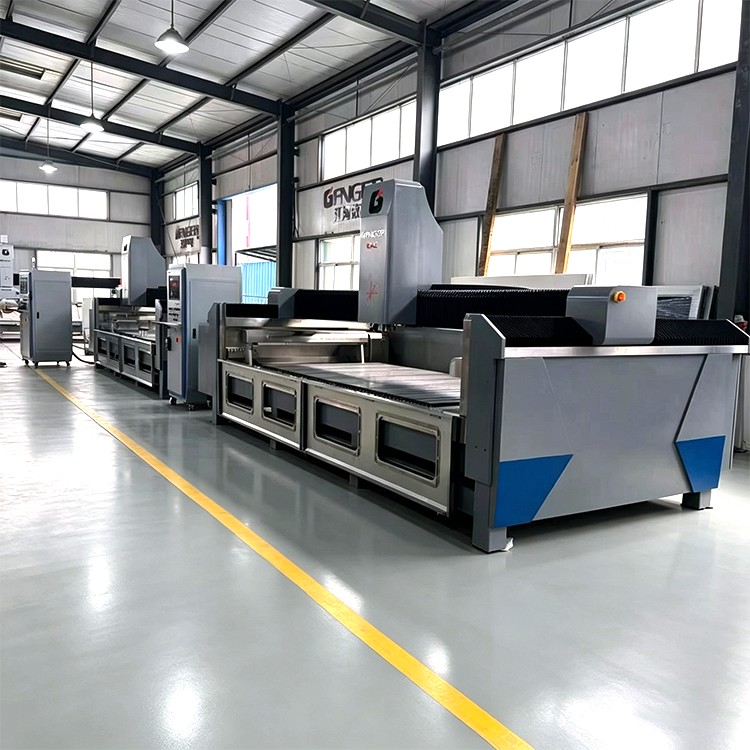
Gnager took advantage of the situation and developed advanced, various stone processing machinery that met the actual production needs, helping domestic
and foreign customers produce high-end and exquisite stones.
Major industry events reflect this transformation. The StonebyPORTUGAL SUMMIT 2026 convened global leaders in July to address green transition, digital
technology, and structural applications. The Xiamen Stone Fair’s 26th edition featured 2,000 exhibitors under the theme “The Sensory Theater of Stone,”
showcasing design-driven innovation. As the industry confronts tariffs, bans, and technological disruption, one truth is clear: the future belongs to those who
embrace sustainability, precision, and the enduring value of natural stone.
Leave A Reply

JINAN GANGER CNC TECHNOLOGY CO., Ltd. has rich experience in research, development and production of CNC products. We provide customers with professional products and services in the stone processing industry.
Contact
Leave a Message Online